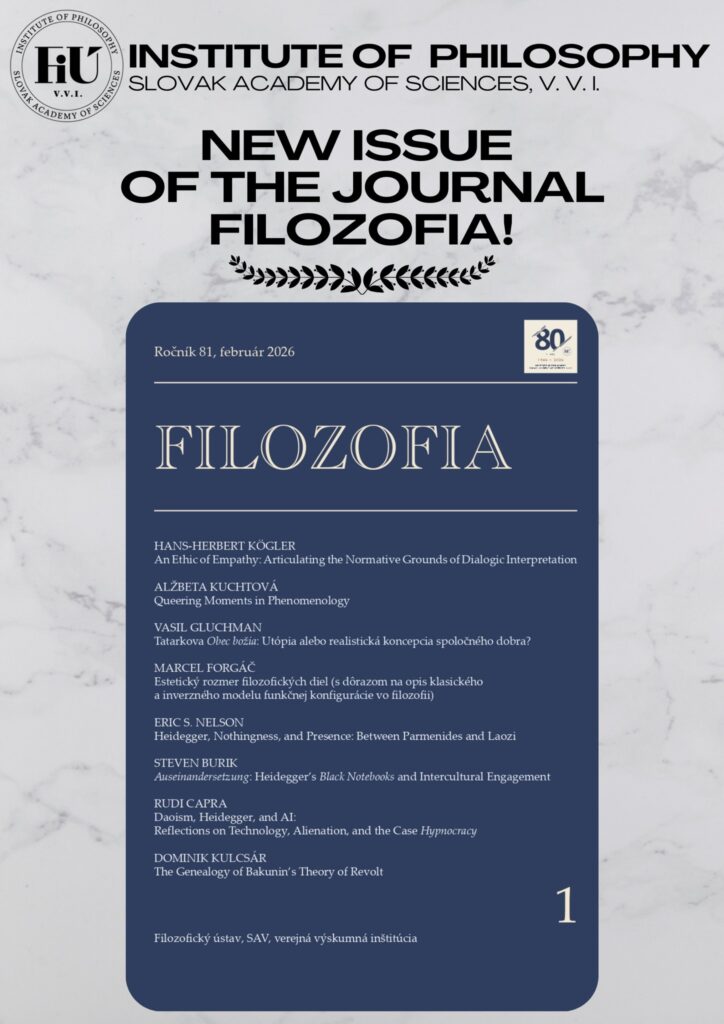


Issue 1 (February 2026) of the academic journal Filozofia has just been published on the journal’s website!
Filozofia is a double-blind peer-reviewed journal, open to all authors regardless of methodology or philosophical orientation.
The editor-in-chief of the journal is Jon Stewart (Filozofický ústav SAV).
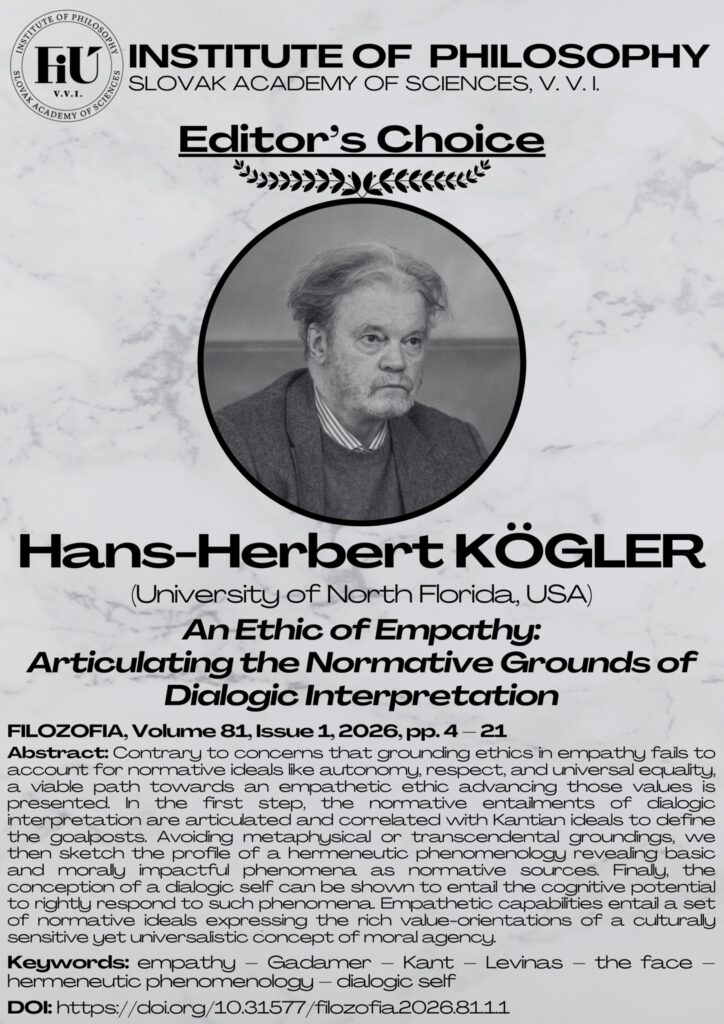
Editor’s choice: A research paper entitled “An Ethic of Empathy: Articulating the Normative Grounds of Dialogic Interpretation” (in English), authored by Hans-Herbert KÖGLER (University of North Florida, USA).
Contrary to concerns that grounding ethics in empathy fails to account for normative ideals like autonomy, respect, and universal equality, a viable path towards an empathetic ethic advancing those values is presented. In the first step, the normative entailments of dialogic interpretation are articulated and correlated with Kantian ideals to define the goalposts. Avoiding metaphysical or transcendental groundings, we then sketch the profile of a hermeneutic phenomenology revealing basic and morally impactful phenomena as normative sources. Finally, the conception of a dialogic self can be shown to entail the cognitive potential to rightly respond to such phenomena. Empathetic capabilities entail a set of normative ideals expressing the rich value-orientations of a culturally sensitive yet universalistic concept of moral agency.
Hans-Herbert Kögler (1960) is a German-American philosopher whose work is situated at the intersection of contemporary social philosophy, hermeneutics, and critical theory. He received his doctoral degree under the supervision of Jürgen Habermas and later built an academic career in the United States, most notably as a professor of philosophy at the University of North Florida. Kögler is best known for developing the concept of critical hermeneutics, which combines interpretive understanding with a systematic analysis of power, domination, and social conflict. In his influential book The Power of Dialogue, he argues that dialogue is not only a method of interpretation but also a normative foundation for critique and social transformation. His later work expands these ideas into a theory of dialogical cosmopolitanism, offering philosophical resources for addressing cultural plurality, global injustice, and intercultural understanding in a globalized world.
Contents:
- Jon STEWART (Filozofický ústav SAV, Bratislava) – “80 Years of the Institute of Philosophy of the Slovak Academy of Sciences as an Integral Part of Filozofia’s History” (in English/Slovak).
- Hans-Herbert KÖGLER (University of North Florida, USA) – “An Ethic of Empathy: Articulating the Normative Grounds of Dialogic Interpretation” (in English).
- Alžbeta KUCHTOVÁ (Filozofický ústav SAV, Bratislava) – “Queering Moments in Phenomenology” (in English).
- Vasil GLUCHMAN (Prešovská univerzita, Prešov) – “Tatarkova Obec božia: Utópia alebo realistická koncepcia spoločného dobra?” (in Slovak).
- Marcel FORGÁČ (Prešovská univerzita, Prešov) – “Estetický rozmer filozofických diel (s dôrazom na opis klasického a inverzného modelu funkčnej konfigurácie vo filozofii)” (in Slovak).
- Kurt C.M. MERTEL (American University of Sharjah, Sharjah, United Arab Emirates) – “Introduction to the Monothematic Block: Heidegger, Daoism, and Intercultural Thinking Today” (in English).
- Eric S. NELSON (The Hong Kong University of Science and Technology – HKUST, Hong Kong) – “Heidegger, Nothingness, and Presence: Between Parmenides and Laozi” (in English).
- Steven BURIK (Singapore Management University, Singapore) – “Auseinandersetzung: Heidegger’s Black Notebooks and Intercultural Engagement” (in English).
- Rudi CAPRA (University of Wuhan, Wuhan, China) – “Daoism, Heidegger, and AI: Reflections on Technology, Alienation, and the Case Hypnocracy” (in English).
- Dominik KULCSÁR (Filozofický ústav SAV, Bratislava) – “The Genealogy of Bakunin’s Theory of Revolt” (Review Study in English).
Editor-in-chief Jon Stewart (Filozofický ústav SAV) writes in the editorial: “Philosophy is about the love of wisdom, critical thinking, fact-checking, and a distrust of ready-made data. To do philosophy is to live by philosophy.”
The journal Filozofia promotes the idea of open science. All articles published in the journal are therefore available to readers free of charge.
You can find the current issue here: https://filozofia.sav.sk/en/current/issue