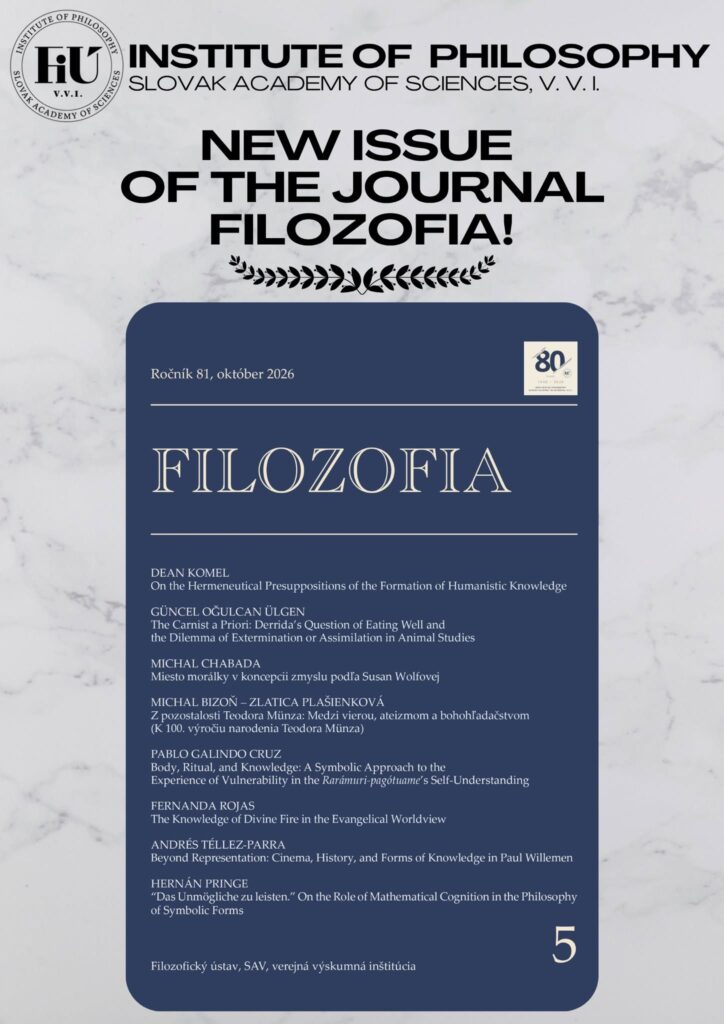
Issue 5 (October 2026) of the academic journal Filozofia has just been published on the journal’s website!
Filozofia is a double-blind peer-reviewed journal, open to all authors regardless of methodology or philosophical orientation.
The editor-in-chief of the journal is prof. h. c. Jon Stewart, PhD., DrSc., Dr. habil. phil. et theol. (Filozofický ústav SAV).
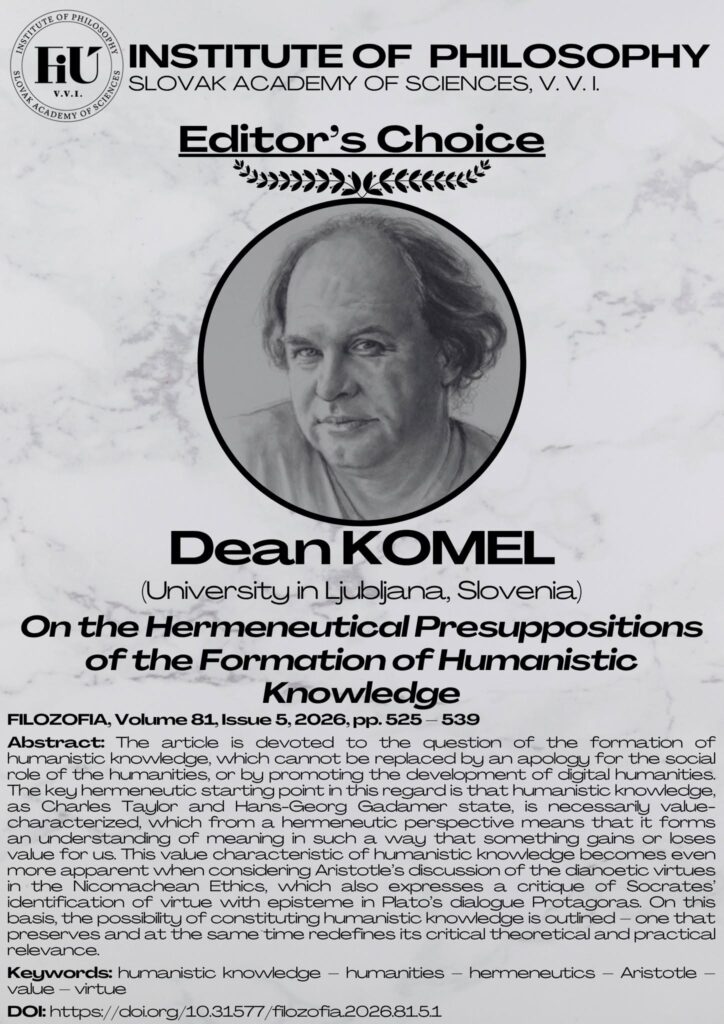
Editor’s choice: A research paper entitled “On the Hermeneutical Presuppositions of the Formation of Humanistic Knowledge” (in English), authored by Dean Komel (University in Ljubljana, Slovenia).
Dean Komel, PhD, is a Slovenian philosopher and Professor of Contemporary Philosophy and Philosophy of Culture at the Department of Philosophy, Faculty of Arts, University of Ljubljana. He also serves as Head of Research at the Institute Nova Revija for the Humanities, a position he has held since 2005. He studied philosophy and comparative literature at the University of Ljubljana and pursued further studies in Germany under Bernhard Waldenfels and Klaus Held. He received his doctorate in 1995 with a dissertation examining hermeneutic phenomenology and the limits of philosophical anthropology. From 2002 to 2005, he headed the Department of Philosophy at the University of Ljubljana. In 2003, he received the Republic of Slovenia’s Zois Award for outstanding scientific achievements in philosophy.
His research centres on phenomenology, philosophical and cultural hermeneutics, and the question of philosophy’s significance in the contemporary world. His work addresses language, historicity, art, intercultural understanding, philosophical terminology and translation, and the intellectual and social role of the humanities. He also contributes to debates on culture, politics, and society and serves on editorial and scientific boards of philosophical and cultural publications.
Contents:
- Dean Komel (University in Ljubljana, Slovenia) – “On the Hermeneutical Presuppositions of the Formation of Humanistic Knowledge” (in English).
- Güncel Oğulcan Ülgen (Hacettepe University, Ankara, Türkiye) – “The Carnist a Priori: Derrida’s Question of Eating Well and the Dilemma of Extermination or Assimilation in Animal Studies” (in English).
- Michal Chabada (Univerzita Komenského v Bratislave) – “Miesto morálky v koncepcii zmyslu podľa Susan Wolfovej” (in Slovak).
- Michal Bizoň, Zlatica Plašienková (Univerzita Komenského v Bratislave) – “Z pozostalosti Teodora Münza: Medzi vierou, ateizmom a bohohľadačstvom (K 100. výročiu narodenia Teodora Münza)” (Essay in Slovak).
- Gustavo Esparza (Universidad Panamericana, Aguascalientes, Mexico) – “Introduction to the Monthematic Block: Cultural Objects of Experience: A Symbolic Approach” (in English).
- Pablo Galindo Cruz (Universidad Panamericana, Aguascalientes, Mexico) – “Body, Ritual, and Knowledge: A Symbolic Approach to the Experience of Vulnerability in the Rarámuri-pagótuame’s Self-Understanding” (in English).
- Fernanda Rojas (Universidad Panamericana, Aguascalientes, Mexico) – “The Knowledge of Divine Fire in the Evangelical Worldview” (in English).
- Andrés Téllez-Parra (Universidad Panamericana, Aguascalientes, Mexico) – “Beyond Representation: Cinema, History, and Forms of Knowledge in Paul Willemen” (in English).
- Hernán Pringe (Universidad Diego Portales, Chile) – ““Das Unmögliche zu leisten”: On the Role of Mathematical Cognition in the Philosophy of Symbolic Forms” (in English).
- Gustavo Esparza (Universidad Panamericana, Aguascalientes, Mexico) – “Jean Lassègue: Cassirer’s Transformation: From a Transcendental to a Semiotic Philosophy of Forms” (Book review in English).
The journal Filozofia promotes the idea of open science. All articles published in the journal are therefore available to readers free of charge.
Under the editorial leadership of Jon Stewart (Filozofický ústav SAV), Filozofia has significantly broadened its readership and strengthened its international scholarly presence. In recent years, the journal has gained greater visibility and academic recognition, attracting contributions from distinguished scholars across the world. Its increasingly international profile has enriched the range of philosophical perspectives represented in its pages and enhanced its role as a forum for substantive scholarly dialogue. These developments have further consolidated Filozofia’s standing as a respected platform for philosophical research within the global academic community.
The current issue can be found here: https://filozofia.sav.sk/en/current/issue